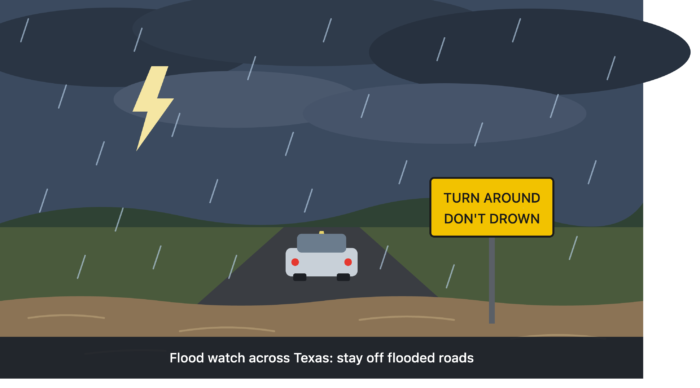
Texas Drivers, Take It Slow: Flood Risk Across the State Today
Friday, October 2, 2026
If you’re driving in Texas today, the weather is the story. A slow-moving system has been soaking much of the state, and the risk of flash flooding on roads is real. Here’s what’s going on and how to stay safe.
What’s happening
A Flood Watch covers much of South Central Texas, and the National Weather Service warns that a cold front combined with tropical moisture could bring life-threatening flash flooding. Moisture from the remnants of Hurricane Polo is feeding the heavy rainfall potential. Rain totals are significant: most of South Central Texas could see 1 to 4 inches through Friday, with 4 to 6 inches in the Hill Country and Winter Garden regions, and isolated pockets reaching 6 to 8 inches. Austin/San Antonio, TX +2
The threat isn’t limited to one region:
- San Antonio and South Central Texas: Street flooding is the main concern in urban areas, and low water crossings are the biggest worry, with the Friday morning commute especially affected. ksat
- Austin and the I-35 corridor: The flood watch continues through Friday evening and now extends east to Fayette and Lee counties, with periods of heavy rain possible at any time on Friday. kxan
- Dallas-Fort Worth and North Texas: The flood watch has been expanded and extended through Friday afternoon, and isolated additional rainfall of 2 to 4 inches could cause flooding. weather
- Central Texas (Bosque County): A flash flood warning was issued this morning, with warnings of life-threatening flooding of creeks, highways, streets and underpasses, plus possible debris flows near the Hydra fire burn scar. cedarnews
There’s some relief ahead. Rain is expected to linger through Sunday before ending, with sunny, dry weather next week. weather
Why flooded roads are so dangerous
Most people underestimate moving water. Roughly six inches can knock an adult off their feet, about a foot can carry away a small car, and two feet can float a truck or SUV. You also can’t tell how deep water is, or whether the road beneath it is still there, by looking at it. That’s why the National Weather Service puts it so bluntly: most flood deaths occur in vehicles. mysanantonio
Safety checklist for today’s drive
Before you go
- Check whether your route crosses low-water crossings, creeks or underpasses, and plan an alternative. Apps like Google Maps or Waze, or the DriveTexas map from TxDOT, can help.
- Ask yourself if the trip is necessary. If you can delay it until the rain eases, do.
- Make sure your phone is charged, and keep emergency alerts turned on.
- Check your tires, wipers and lights. Worn tires and streaky wipers are much more dangerous in a downpour.
On the road
- Turn around, don’t drown. Never drive through water covering the road, even if it looks shallow or you’ve crossed it before. Forecasters have been repeating this warning all week. mysanantonio
- Slow down. Hydroplaning can start at surprisingly low speeds when water builds up under your tires. If you start to hydroplane, ease off the gas, keep the wheel straight and don’t slam the brakes.
- Leave extra space. Double or triple your normal following distance.
- Use your headlights, not your hazards. In Texas, driving with hazards on in motion can confuse other drivers.
- Watch for ponding in the left lane and at underpasses. Water collects there first.
- Pull over safely if visibility drops to near zero. Choose a spot away from creeks, trees and power lines, and wait it out with your lights on.
If your car stalls in rising water
- Don’t try to restart it.
- Get out immediately and move to higher ground if you can do so safely.
- If you’re trapped, call 911.
Know your alerts
- Flood Watch: Conditions are favorable for flooding. Be prepared and stay aware.
- Flash Flood Warning: Flooding is happening or about to happen. Move to safety and stay off flooded roads.
Special note: events and crowds
This weekend’s flooding window overlaps with big gatherings. The Austin watch overlaps with the first day of the Austin City Limits Music Festival, one of the city’s largest outdoor events. If you’re headed to an event, expect slow traffic, flooded parking areas and delays. Build in extra time and have a backup plan for getting home. kut
The bottom line
Conditions can change quickly, so check the National Weather Service (weather.gov) or your local station before and during any drive. A delayed trip is an inconvenience. A flooded road can be fatal. Stay safe, Texas.
Disclaimer: This article is provided for general informational and safety awareness purposes only and does not constitute legal advice. Traffic laws, road closures, and emergency orders vary by city, county, and situation, and may change quickly. For questions about your legal rights or responsibilities, such as liability, insurance claims, or traffic violations, consult a licensed attorney. Weather conditions are changing, so always follow guidance from the National Weather Service, local emergency management officials, and law enforcement.
